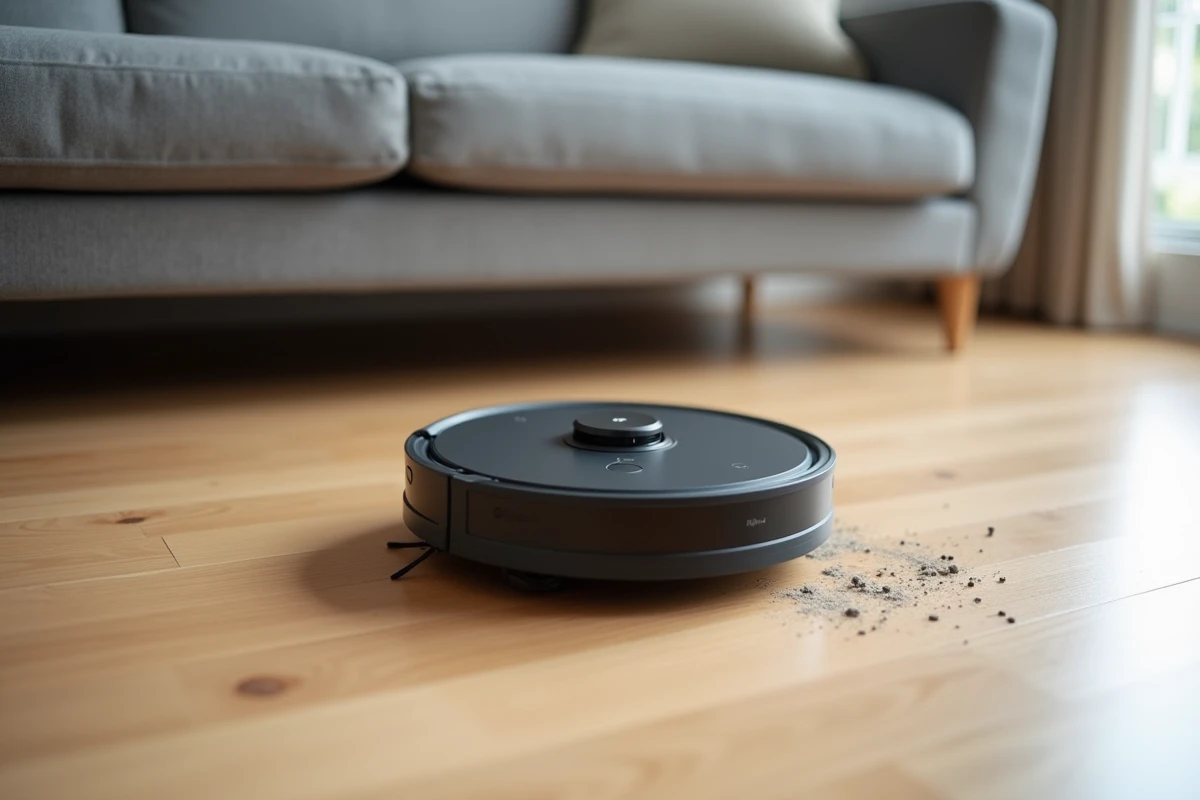
The technical specifications of robot vacuums display increasingly higher values in pascals (Pa), sometimes exceeding 15,000 or 30,000 Pa. These figures influence purchasing decisions, but they are based on measurements that each manufacturer conducts according to its own method. Comparing two robots solely based on their Pa is akin to comparing two scores given by different juries, with different grading scales.
Pa Comparison and Real Efficiency: What Independent Tests Show
Tests conducted by Que Choisir in 2024 reveal a discrepancy between the advertised values and the actual collection results. Robots that show modest power on paper rank among the best in effective dust collection, while models with very high advertised power do not perform significantly better on hard floors or short-pile carpets.
| Advertised Pa Range | Performance on Hard Floor | Performance on Short Pile Carpet | Noise Level |
|---|---|---|---|
| Less than 3,000 Pa | Fair to Good | Variable depending on brushes | Low |
| 3,000 to 5,000 Pa | Good to Very Good | Good | Moderate |
| More than 7,000 Pa | Very Good | Slightly Better | High |
The cleaning gain between the 3,000-5,000 Pa range and the range above 7,000 Pa remains marginal on these two types of surfaces. Beyond a certain threshold, the increase in Pa hardly improves collection, while noise and energy consumption increase significantly.
An article detailing the power in Pa of robot vacuums confirms that the threshold around 3,000 Pa already constitutes a sufficient suction level for the vast majority of domestic uses.
Non-Standardized Pa Measurement: Why the Numbers Mislead
No international standard requires manufacturers to use a single method for measuring suction power in pascals. Each brand uses its own testing protocol, making comparisons between brands technically unreliable.
The British consumer association Which? highlights this issue: the “suction power” values communicated are not directly comparable from one manufacturer to another. A robot advertised at 10,000 Pa from one brand could have suction equivalent to a model displayed at 6,000 Pa from a competitor, depending on the measurement conditions used.
This lack of standardization fuels marketing inflation. The numbers rise from one product generation to the next without reflecting a proportional improvement in actual cleaning. Three elements explain these measurement discrepancies:
- The distance between the test nozzle and the surface varies according to internal protocols, which directly alters the obtained value
- Some manufacturers measure the maximum vacuum without load (without obstacles or filters), while others measure under conditions closer to actual use
- The “boost” or “turbo” mode often serves as the reference for the displayed number, even though this mode is not the one used during regular operation
Suction Criteria Beyond Pa: Brushes, Airflow, and Filtration
The raw power in pascals represents only part of the equation. The airflow determines the volume of dust transported to the bin, while the vacuum (the Pa) measures the force exerted to dislodge particles. A robot may display high vacuum but limited airflow, which reduces its ability to effectively expel debris.
The type of brush plays a role at least as significant as the power. A multisurface rubber brush dislodges pet hair better than a traditional bristle brush, regardless of the number of Pa. Rowenta and Que Choisir remind us that the quality of the brushes influences the result on carpets more than the power value alone.
The filtration system also matters. A clogged filter reduces airflow and thus overall efficiency, even on a very powerful model. Regular filter maintenance maintains performance much more reliably than an excess of Pa at the time of purchase.
Appropriate Suction Power According to Floor Type and Use
On hard floors (tiles, wood, vinyl), most robots on the market vacuum correctly from the first power ranges. Particles rest on the surface and do not require high vacuum to be captured.
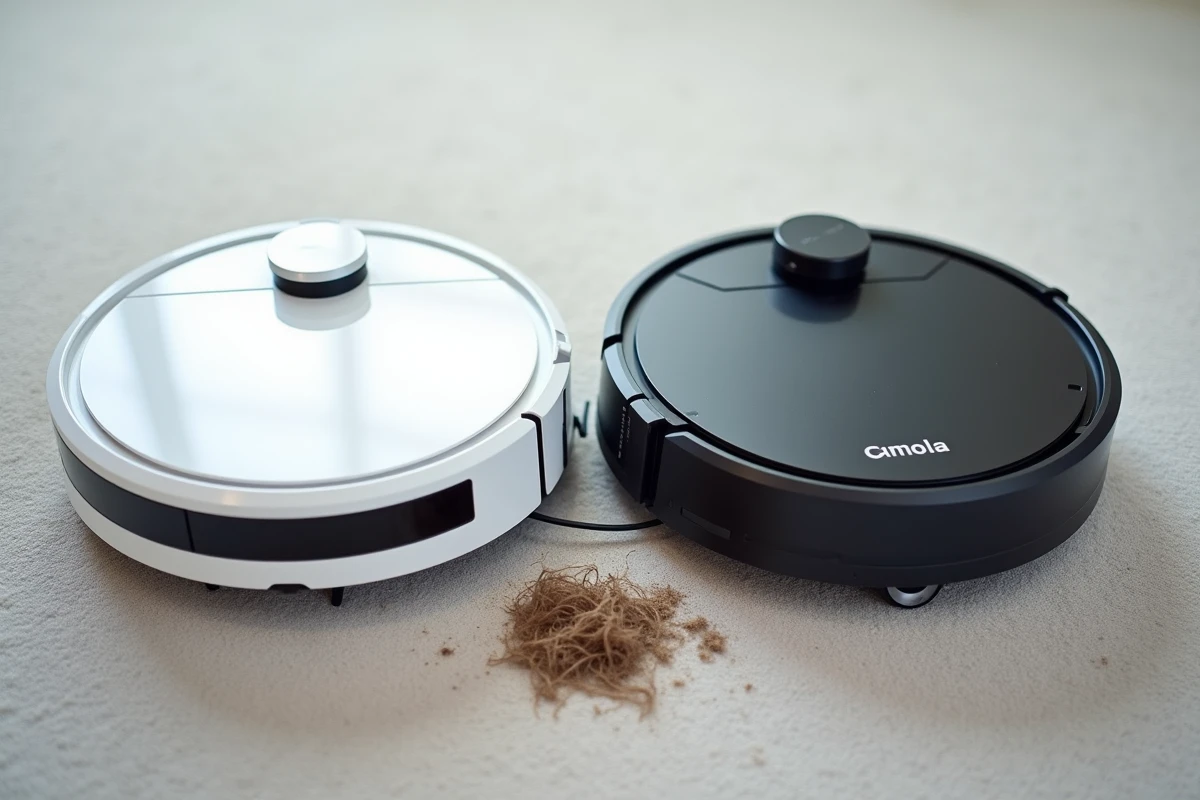
The situation changes on long-pile carpets or thick rugs. Debris sinks between the fibers, and a robot must exert a stronger vacuum to extract them. For households with thick carpets or pets, aiming for the 3,000 to 5,000 Pa range offers a good compromise between efficiency and battery life.
- Hard floor only: a model under 3,000 Pa is suitable in most cases, with a reduced noise level
- Mix of hard floor and short pile carpet: the 3,000-5,000 Pa range meets needs without overconsumption
- Thick carpets, abundant pet hair: prioritize a robot with a temporary boost mode and rubber brushes rather than a maximum Pa number
The automatic boost mode, present on many recent models, increases power only when the robot detects a carpet. This operation preserves battery life on hard floors and concentrates effort where it is needed.
The race for pascals directs attention to a single number while the cleaning result depends on a set of mechanical and airflow factors. Airflow, brush design, filter maintenance, and adaptive suction mode weigh as much, if not more, than the value displayed on the technical specification. Reading the results of independent tests remains the most reliable way to differentiate between two models.