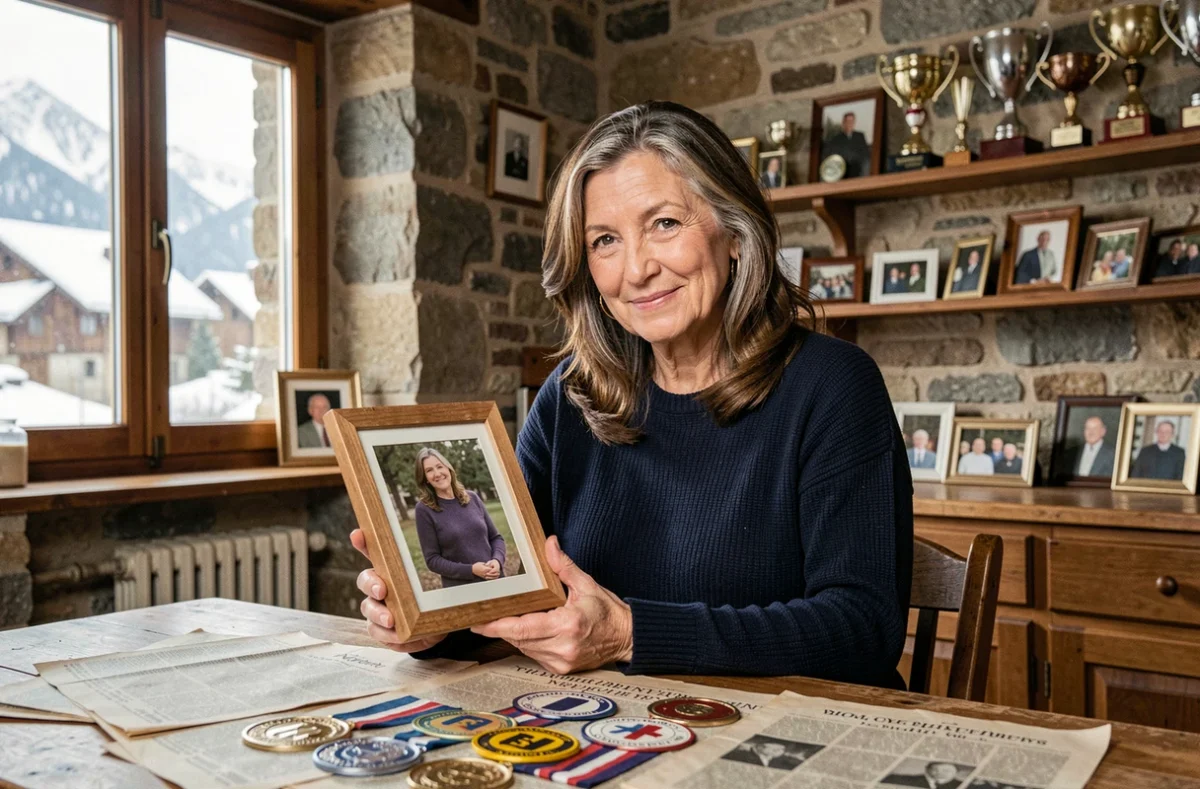
Edgar Grospiron, Olympic mogul skiing champion in 1992, is regularly analyzed in terms of his sports career, his motivational talks, or his recent removal from the presidency of the 2030 Alpine Olympic Games. One angle remains almost absent from public documentation: the role of his mother in shaping this journey.
The available sources provide almost no verified biographical data about this family figure. This observation in itself is revealing about how the Grospiron family manages the boundary between the public sphere and the private sphere.
Media Visibility of the Grospiron Family: What Sources Reveal and What They Conceal
When searching for information about Edgar Grospiron’s family background, one observation stands out: Edgar Grospiron’s mother does not appear in any identifiable institutional sources. Neither official sports biographies, nor national press interviews, nor federal documents mention her by name in a specific role.
The only name that emerges in recent research is that of Nathalie Ville-Grospiron, presented as the mother of Zoé Grospiron, Edgar’s daughter. This generational distinction is significant: the sources that mention Nathalie Ville-Grospiron associate her with the next generation, not directly with the champion’s upbringing.
| Family Member | Media Presence | Documented Role |
|---|---|---|
| Edgar Grospiron | Very high (national press, television, conferences) | 1992 Olympic champion, speaker, former president JO 2030 |
| Zoé Grospiron | Moderate (specialized sports press) | Transition from skiing to longboarding, Basque Country |
| Nathalie Ville-Grospiron | Very low (one barely identifiable source) | Logistical and emotional support for Zoé (unverified) |
| Edgar Grospiron’s Mother | Nonexistent in accessible sources | No documented public role |
This table highlights a considerable gap between the champion’s media coverage and the almost total invisibility of the maternal figure. A more complete portrait of Edgar Grospiron’s family on L’Esprit du Sport allows for a more nuanced exploration of this dimension.
Family Discretion in French Sports: The Grospiron Case Compared to Other Champions
The media erasure of Edgar Grospiron’s mother is not an isolated case in French sports, but it stands out for its extent. Several Olympic champions have seen their parents occupy varying degrees of public space, ranging from occasional interviews to active participation in communication surrounding their child’s career.
The Grospiron family seems to have made a deliberate choice to maintain a strict separation between public life and private life. Documentary research confirms this trend: no regional or national press archive consulted contains direct testimony from Edgar’s mother regarding her experience as a champion’s parent.
This choice produces a measurable effect on public perception. When a high-level athlete becomes a professional speaker, as Edgar Grospiron did after his sports career, the narrative of upbringing takes center stage. Family anecdotes, parental sacrifices, trips to ski resorts become expected narrative elements for audiences.
What This Absence Says About the Family Model
In the Grospiron case, this narrative material remains absent from the public domain. Several hypotheses can be formulated without any being verifiable in the current state:
- A tacit or explicit family agreement for only the athlete to occupy the media space, thus protecting relatives from exposure
- A family culture where parental support is considered a given, not warranting particular spotlight
- A generational context: in the 1980s and 1990s, the parents of athletes were much less solicited by the media than today
The absence of media traces does not mean absence of influence, but it makes any factual analysis of the maternal role impossible without direct testimony.
Sporting Transmission in the Grospiron Family: From Mother to Champion, From Champion to Daughter
One documented element allows for the question of family transmission to be approached from another angle. Zoé Grospiron, Edgar’s daughter, grew up in an environment where skiing was a given. She then turned to longboarding in the Basque Country, undergoing a sports transition that structurally resembles her father’s shift from competitive skiing to professional speaking.
Sources link this trajectory to the influence of the family environment as a whole. Zoé Grospiron’s transition illustrates a transmission pattern where sport remains central but changes form from one generation to the next.
Nathalie Ville-Grospiron, identified as a logistical and emotional support for Zoé, would occupy in this transmission chain a role comparable to that which Edgar’s mother may have played a generation earlier. The symmetry is striking: two maternal figures associated with two Grospiron athletes, and in both cases, public visibility close to zero.
Mother of an Olympic Champion: Why Sources on Edgar Grospiron’s Mother Are Lacking
The lack of documentation on Edgar Grospiron’s mother is also explained by structural factors. Mogul skiing, the discipline in which Edgar was crowned Olympic champion, has never enjoyed the media coverage of football or tennis. In-depth reports on the family background of winter sports champions remain rare outside of Olympic periods.
Regional press archives mention Edgar Grospiron without ever detailing his original family unit. The available articles focus on his public appearances, his positions on the 2030 Games, or his corporate talks.
This documentary gap raises a broader question about how French sports archive and value the role of parents in the development of high-level athletes. French sports federations do not have a tradition of systematic documentation of the family environment, unlike some Anglo-Saxon sports cultures where “sport parents” are the subject of dedicated studies and publications.
A Discreet Role That Escapes Usual Analytical Frameworks
Parental support in competitive skiing involves concrete constraints: frequent travel to resorts, management of adapted school calendars, financing of equipment and training camps. These material and organizational contributions remain invisible in the public narrative of the champion.
The case of Edgar Grospiron’s mother illustrates a reality that the available data does not allow us to quantify but that they outline in relief. The very absence of information constitutes the salient fact: in a family where sporting notoriety spans generations, the maternal figure remains the only link that public documentation does not illuminate.